
Food systems are one of the major drivers of Nature loss and climate disruption, in all regions of the world. Agricultural and land use practices developed in a time when the human population was much smaller, and our industrial resource-extraction capabilities were more modest, are now putting future food security itself at risk. Last month,Continue reading “EAT-Lancet Commission finds food systems can support human & planetary health”
Tag Archives: food
What are food environments and why do they matter?

GFFN Founding Partner, EAT Forum researchers are developing a classification approach to better understand the intersection between food environments, gender, nutrition, and other factors. Read the Brief now!
Financial Markets Roadmap for Transforming the Global Food System
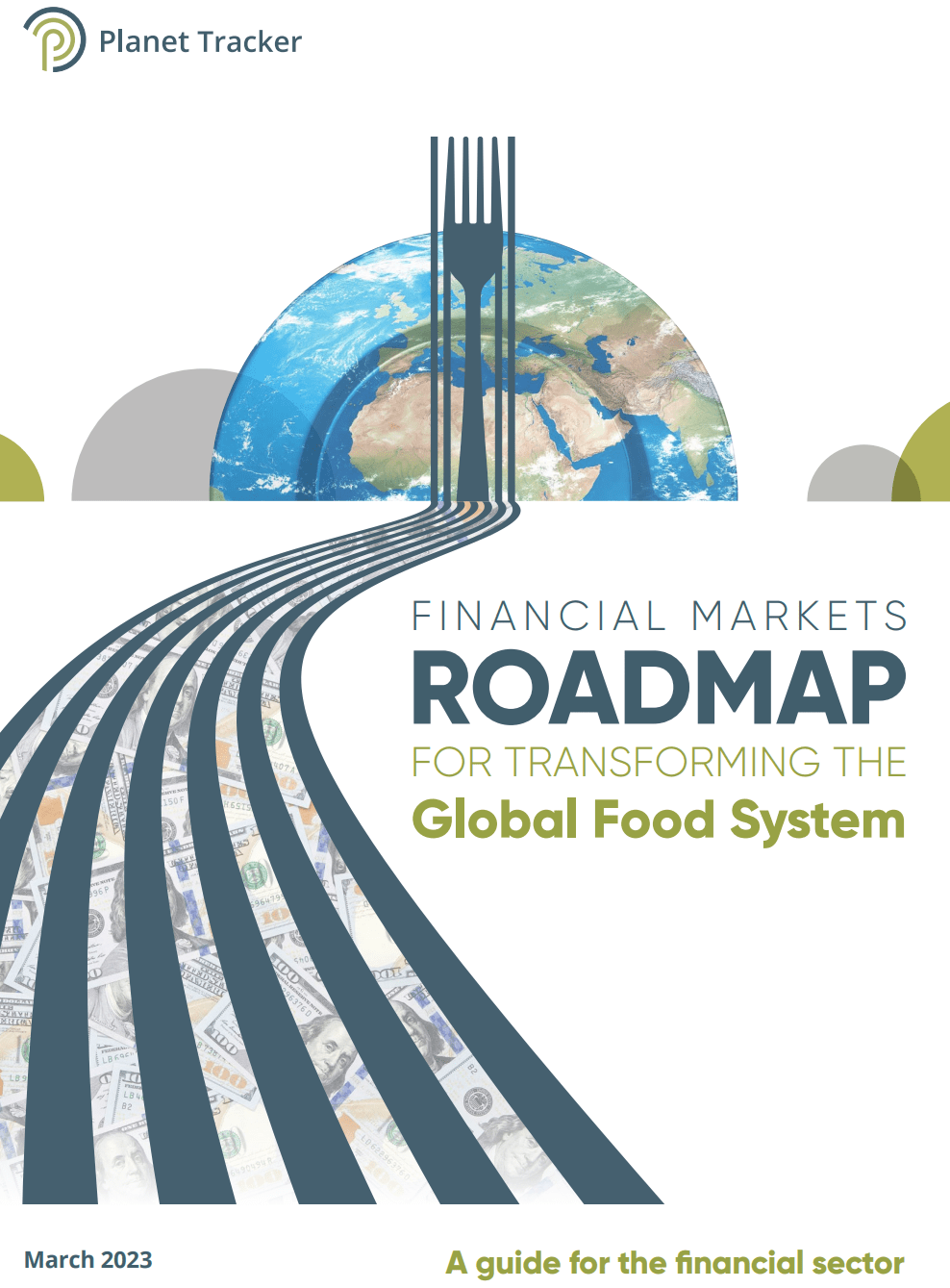
Planet Tracker’s report, ‘Financial Markets Roadmap for Transforming the Global Food System’ sets out clear steps for the financial community to achieve a sustainable food system by 2050
Five-year sprint to transform food-related finance data

In May, the Good Food Finance Network launched the Integrated Data Systems Initiative, as a 5-year innovation sprint linked to AIM for Climate Summit. The goal is to transform the way data systems inform financial decision-making—across the public, private, and multilateral sectors. Read more.
HOT MONEY 40 financial institutions are funding a climate-changing agri-methane footprint

Read the report This report focuses on the 20 investors and 20 banks that are funding the methane-generating activities of 15 of the leading meat and dairy companies worldwide. Collectively these financial institutions fund a methane footprint that could exceed 503 Mt CO2e1 – nearly as big as the CO2 emissions of Saudi Arabia2. TheContinue reading “HOT MONEY 40 financial institutions are funding a climate-changing agri-methane footprint”
Evaluation of the EU support to sustainable agri-food systems in partner countries 2014-2020

This thematic evaluation assesses the performance of EU support to food and nutrition security, sustainable agriculture and fisheries at country, regional and global level over the period 2014-2020.
Stockholm +50 – A new step toward food value chain transformation

GFFN Partner World Business Council for Sustainable Development (WBCSD) and Stokholm Environmental Institute (SEI), in close collaboration with GFFN Partner United Nations Environment Programme (UNEP) launched the Stockholm Action Agenda initiative, outlining priorities and recommendations for action in key sectors, including food and agriculture.
Guide on incentives for responsible investment in agriculture and food systems

To generate sustainable benefits, this investment must be responsible. What role should investment incentives play in encouraging such investment? This Guide helps to answer that question. Specifically, the Guide provides policymakers and government technical staff with guidance on how investment incentives can be used (and how they should not be used) to enhance responsible investment in agriculture and food systems.
 Good Food Finance Network