
Report outlining case studies that demonstrate bankable projects, case studies look at sustainable agriculture and commodity chain development for sustainable cocoa production, forest resilience, marine protected areas, mangroves, and sustainable agroforestry. These case studies can be referenced to better understand how and why initiatives are bankable and successful
Author Archives: GFFN Secretariat
Value beyond value chains: Case study collection

The case studies provide just a few snapshots of how private sector companies and financial actors can support multi-stakeholder initiatives at landscape, subnational and national level in commodity-producing countries. They illustrate, at a high level, how companies can collaborate with governments and other organizations – including other private sector companies – in producer countries, supporting and participating in programmes that go beyond individual value chains to create the enabling conditions for sustainable agricultural production.
Bonn climate talks signal need for good food finance

Discussions at the 2022 Bonn Climate Change Conference (SB56) illustrate that climate-aligned food-related finance is becoming a priority for local communities, national governments, and international cooperation.
Stockholm +50 – A new step toward food value chain transformation

GFFN Partner World Business Council for Sustainable Development (WBCSD) and Stokholm Environmental Institute (SEI), in close collaboration with GFFN Partner United Nations Environment Programme (UNEP) launched the Stockholm Action Agenda initiative, outlining priorities and recommendations for action in key sectors, including food and agriculture.
Investing in Sustainable Food Systems – Insights from the Good Food Finance Week

Opinion piece produced by Farm Animal Investment Risk & Return (FAIRR), GFFN Founding organization, highlighting the Panel on Fiscal and Agricultural Support Policies to Address Climate and Food Security.
Good Food Finance Network proposes co-investment platform to tackle global food security challenges

During the Good Food Finance Week, the GFFN proposed a Co-Investment platform to tackle global food security challenges and announced Rebeca Grynspan, Secretary-General of the United Nations Conference on Trade and Development (UNCTAD), and Wiebe Draijer, CEO of Rabobank as GFFN Co-Chairs. They will provide strategic guidance and serve as high-level leaders representing public, private, and multilateral sectors.
Food System Transformation in Turbulent Times – Interview with GFFN Partners WBCSD and Food Systems for the Future
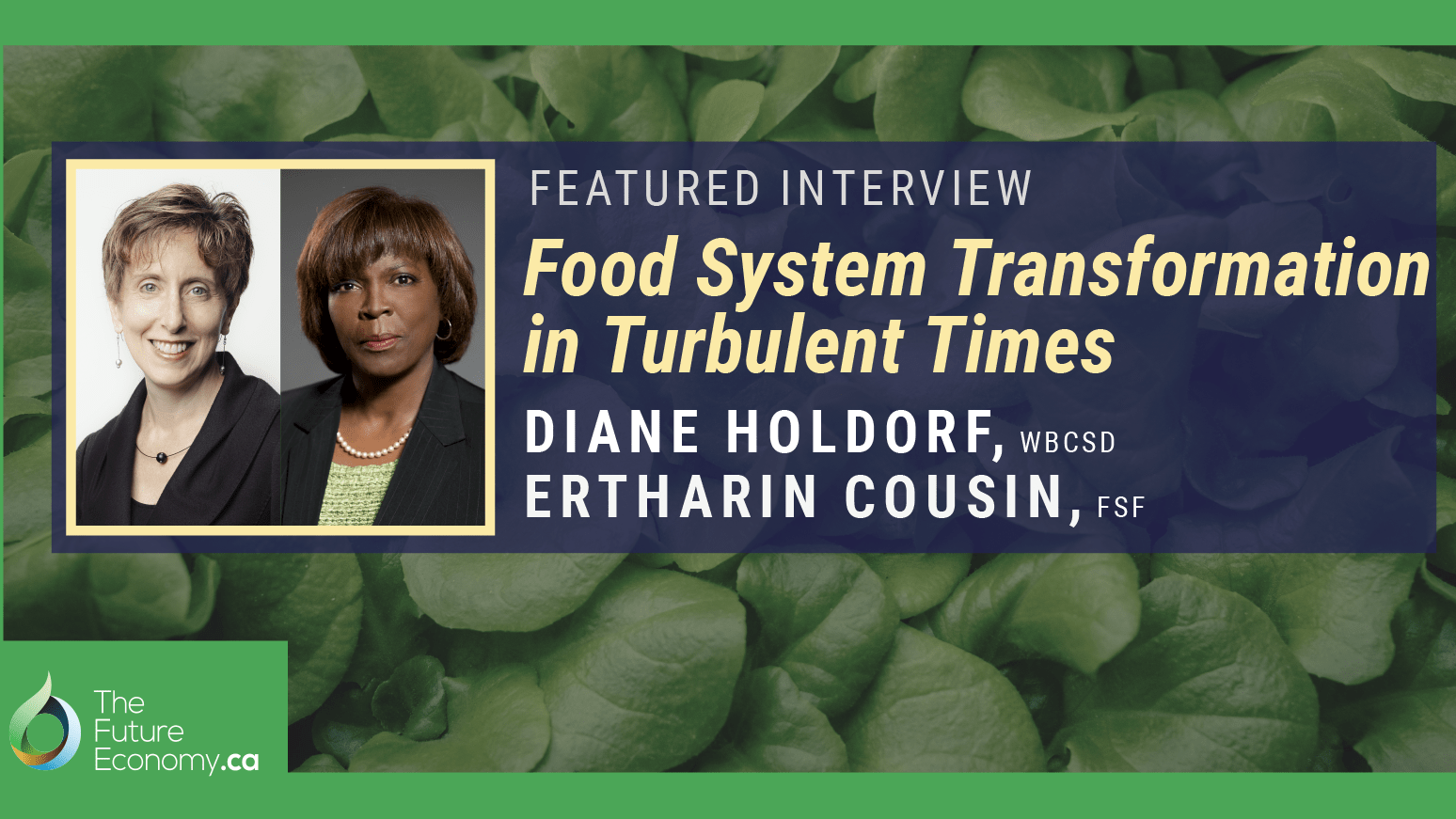
Expert Interview featuring GFFN Principals & core partners Diane Holdorf – Executive Vice President at World Business Council for Sustainable Development (WBCSD) & Ertharin Cousin – CEO and Founder of Food Systems for the Future (FSF) discuss the urgen need for a fast response to food systems transformations and the importance of adequate and accessible financing.
Tracking progress on food and agriculture-related SDG indicators 2022

FAO’s new report, “Tracking progress on food and agriculture-related SDG indicators”, offers analysis and trends on indicators across eight SDGs (1, 2, 5, 6, 10, 12, 14 and 15), highlighting areas of progress and areas where further effort is needed. This edition also includes a snapshot on conflict, COVID-19 and food insecurity, as well as a special chapter on measuring productive and sustainable agriculture, with progress toward SDG Target 2.4 analysed for the first time.
IPCC Sixth Assessment Report

The IPCC is now in its sixth assessment cycle, in which the IPCC is producing the Sixth Assessment Report (AR6) with contributions by its three Working Groups and a Synthesis Report, three Special Reports, and a refinement to its latest Methodology Report, presenting the most advanced and recent knowledge on global warming and climate change while highlighting the responsibility of humans in the latter. The most recent IPCC report 2022 warned that the world is set to reach the 1.5ºC level within the next two decades and said that only the most drastic cuts in carbon emissions from now would help prevent an environmental disaster.
State of Finance for Nature in the G20 Report

The State of Finance for Nature in the G20 report attempts to capture the complete amount and future need for G20 country spending on nature-based solutions assets and activities. It reveals that current G20 investments in nature-based solutions are insufficient, at USD 120 billion/year, and G20 Official Development Assistance and private sector investments are small when compared with domestic government spending. It builds on the global report ‘State of Finance for Nature – Tripling Investments in Nature-Based Solutions by 2030’ released in 2021, which calls for closing a USD 4.1 trillion financing gap in nature-based solutions.
 Good Food Finance Network