
Report outlining case studies that demonstrate bankable projects, case studies look at sustainable agriculture and commodity chain development for sustainable cocoa production, forest resilience, marine protected areas, mangroves, and sustainable agroforestry. These case studies can be referenced to better understand how and why initiatives are bankable and successful
Category Archives: Report
Value beyond value chains: Case study collection

The case studies provide just a few snapshots of how private sector companies and financial actors can support multi-stakeholder initiatives at landscape, subnational and national level in commodity-producing countries. They illustrate, at a high level, how companies can collaborate with governments and other organizations – including other private sector companies – in producer countries, supporting and participating in programmes that go beyond individual value chains to create the enabling conditions for sustainable agricultural production.
Tracking progress on food and agriculture-related SDG indicators 2022

FAO’s new report, “Tracking progress on food and agriculture-related SDG indicators”, offers analysis and trends on indicators across eight SDGs (1, 2, 5, 6, 10, 12, 14 and 15), highlighting areas of progress and areas where further effort is needed. This edition also includes a snapshot on conflict, COVID-19 and food insecurity, as well as a special chapter on measuring productive and sustainable agriculture, with progress toward SDG Target 2.4 analysed for the first time.
IPCC Sixth Assessment Report

The IPCC is now in its sixth assessment cycle, in which the IPCC is producing the Sixth Assessment Report (AR6) with contributions by its three Working Groups and a Synthesis Report, three Special Reports, and a refinement to its latest Methodology Report, presenting the most advanced and recent knowledge on global warming and climate change while highlighting the responsibility of humans in the latter. The most recent IPCC report 2022 warned that the world is set to reach the 1.5ºC level within the next two decades and said that only the most drastic cuts in carbon emissions from now would help prevent an environmental disaster.
State of Finance for Nature in the G20 Report

The State of Finance for Nature in the G20 report attempts to capture the complete amount and future need for G20 country spending on nature-based solutions assets and activities. It reveals that current G20 investments in nature-based solutions are insufficient, at USD 120 billion/year, and G20 Official Development Assistance and private sector investments are small when compared with domestic government spending. It builds on the global report ‘State of Finance for Nature – Tripling Investments in Nature-Based Solutions by 2030’ released in 2021, which calls for closing a USD 4.1 trillion financing gap in nature-based solutions.
Guide on incentives for responsible investment in agriculture and food systems

To generate sustainable benefits, this investment must be responsible. What role should investment incentives play in encouraging such investment? This Guide helps to answer that question. Specifically, the Guide provides policymakers and government technical staff with guidance on how investment incentives can be used (and how they should not be used) to enhance responsible investment in agriculture and food systems.
‘Food Finance Architecture: Financing a Healthy, Equitable and Sustainable Food System’ report launched at UN Summit
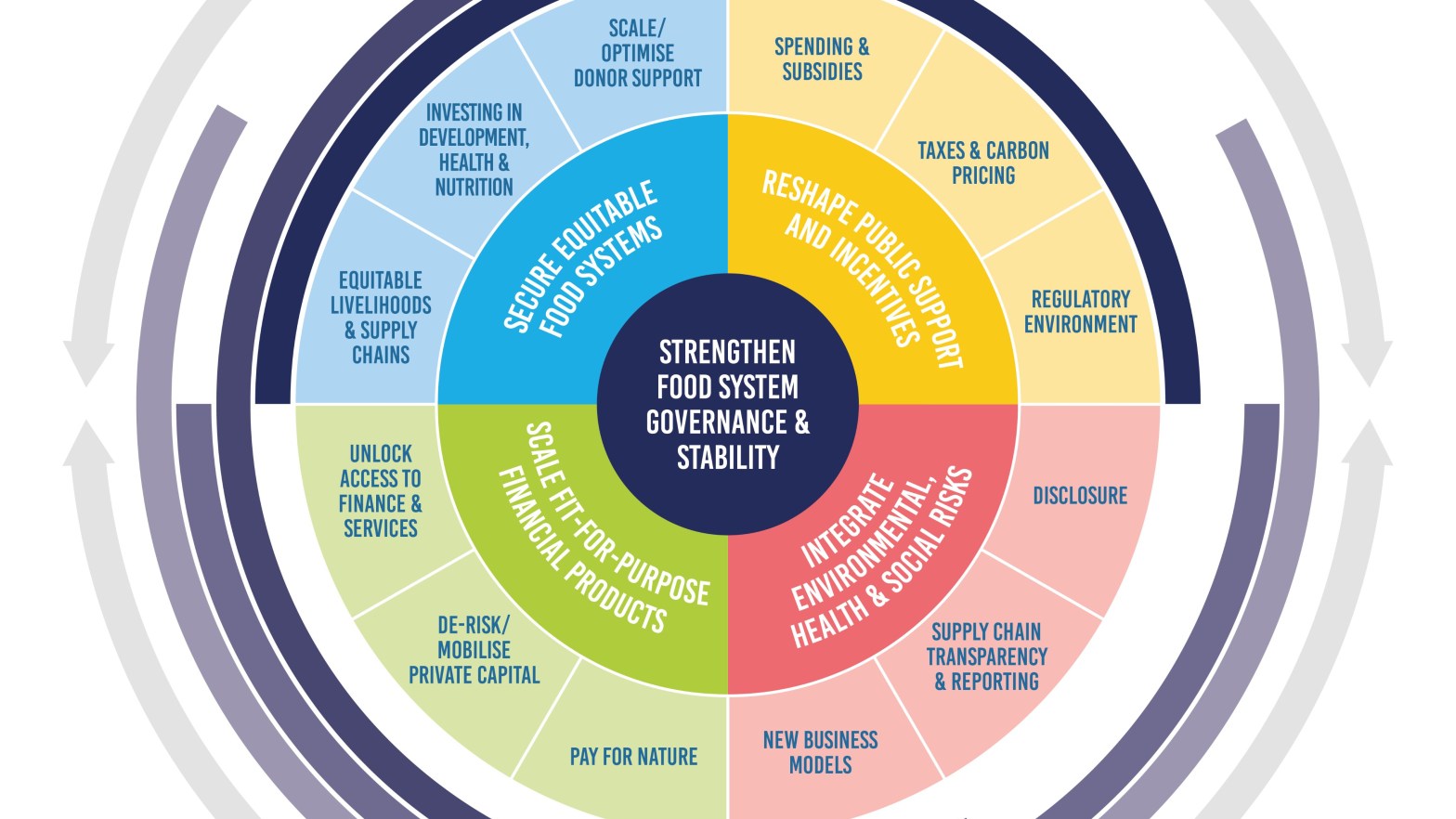
The United Nations Food Systems Summit launched the ‘Food Finance Architecture’ publication and policy brief, outlining the building blocks for how banks, investors, development institutions, companies, farmers, and governments can shift capital out of high-carbon, unequal, extractive food assets and into inclusive, climate-smart, circular business models that benefit the people and planet.
A Multi-Billion-Dollar Opportunity: Repurposing agricultural support to transform food systems
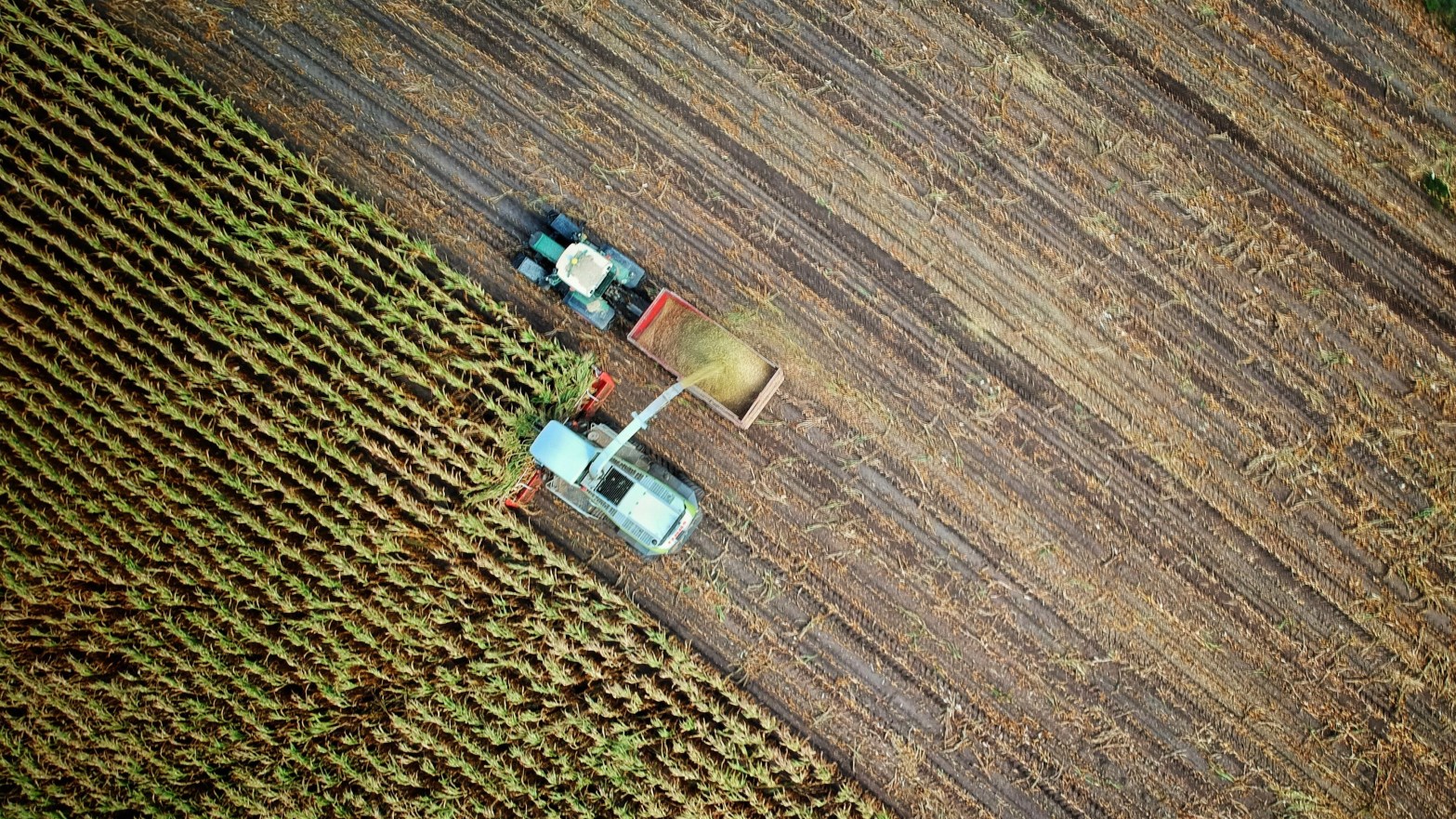
This joint FAO-UNDP-UNEP report calls for governments to rethink the way agriculture is subsidized and supported. The majority (87%) of $540 billion of support to agricultural producers is either price distorting or harmful to nature and health. Repurposing this support can help transform food systems and achieve the SDGs.
Making Finance Work for Food: Financing the Transition to a Sustainable Food System

This Finance for Biodiversity (F4B) report is the first to cover the interplay between food and finance. It has been prepared in the context of F4B’s collaboration with the Food System Economics Commission (FSEC), and as a contribution to the UN Food Systems Summit, as well as ongoing international climate and biodiversity negotiations.
Food Systems in Conflict and Peacebuilding Settings: Pathways and Interconnections

The objectives of this three-part policy paper series are to emphasize the urgency of addressing the relationship between conflict and food insecurity and to point out existing opportunities to do so. This paper, the first in the series, aims, firstly, to inform policymakers of the intricate relationships between food security and violent conflict, secondly, to alert policymakers to the potential ability of food systems to contribute to peace, and then to highlight the action required to enhance this potential.
 Good Food Finance Network